
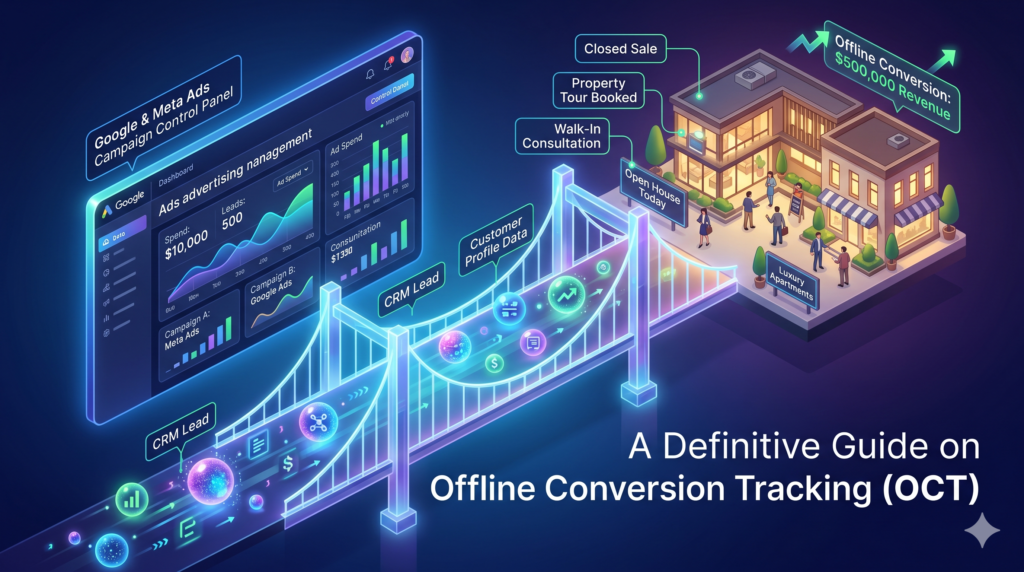
Offline Conversion Tracking (OCT) is a server-side data pipeline that syncs real-world sales events—like property tour bookings, in-store purchases, or closed deals—back to ad platforms such as Meta and Google Ads. By feeding actual revenue signals into Smart Bidding algorithms, OCT shifts campaign optimization from cheap form fills toward high-LTV customers, directly improving ROAS and reducing wasted ad spend.
Thank you for reading this post, don't forget to subscribe!TL;DR
- OCT closes the loop between digital ad clicks and offline conversions using deterministic identifiers (GCLID, FBCLID) and hashed first-party PII.
- Meta’s legacy Offline Conversions API is being deprecated by May 2025—migration to the Conversions API (CAPI) is mandatory.
- Mid-funnel milestones (Tour Booked, Qualified Lead) outperform waiting for final sales, especially in long sales cycles.
- Match rates below 70% indicate normalization failures; SHA-256 hashing requires lowercase emails and trimmed whitespace.
- Dynamic revenue syncing—not static lead values—unlocks Target ROAS bidding for high-ticket retail and real estate brands.
What Is Offline Conversion Tracking and Why Does It Matter?
Offline Conversion Tracking is the architectural bridge that connects offline sales events to the original digital ad interaction that produced them. Standard browser-based tracking only captures form submissions, button clicks, and page visits—events that happen entirely on your website. For high-ticket categories like real estate, automotive, luxury retail, and B2B SaaS, those browser events represent only the top of the funnel. The actual revenue is generated weeks later through site visits, in-store consultations, or signed contracts.
Without OCT, platforms like Meta Ads Manager and Google Ads operate blind to true outcomes. Smart Bidding algorithms assume every lead carries equal weight, optimizing for cheap form fills rather than qualified buyers. The result is a predictable downward spiral: top-of-funnel volume rises, lead-to-customer rates collapse, and actual Cost Per Acquisition (CPA) skyrockets. OCT solves this by feeding real revenue signals back into the algorithms.
How Does Offline Conversion Tracking Improve ROAS?
OCT improves Return on Ad Spend by replacing assumed lead values with dynamic, real-world revenue data. Instead of treating every lead as a generic conversion event, the system passes actual deal values from your CRM directly into Meta CAPI and Google Ads via Enhanced Conversions for Leads (ECL).
This unlocks two critical bidding optimizations. First, Target ROAS bidding can finally distinguish between a lead worth $5,000 and one worth $500,000—budget automatically shifts toward audiences generating premium revenue. Second, mid-funnel milestone tracking (Qualified Lead, Property Tour Booked, In-Store Consultation) gives algorithms training signals weeks before a deal closes, which is essential when sales cycles exceed Google’s GCLID expiration window.
For long-cycle industries, the strategic move is layering multiple conversion actions: an initial Lead event, a mid-funnel Qualified event with partial value, and a Closed-Won event with full revenue. This compound feedback loop trains AI bidding models on the entire customer journey, not just the entry point.
What Are the Core Mechanics: Identifiers and the iOS Impact?
OCT relies on two distinct data-matching methods. Relying on only one creates major signal loss, especially across iOS traffic.
| Tracking Method | What It Captures | Best For | Vulnerability |
|---|---|---|---|
| Deterministic (Click IDs) | GCLID, FBCLID, MSCLKID appended to URLs | Android, desktop, direct attribution | Stripped by Safari ITP and iOS ATT |
| Probabilistic (Hashed PII) | Email, phone, name, address (SHA-256) | iOS traffic, privacy-first matching | Requires strict normalization |
| Privacy-Preserving (WBRAID/GBRAID) | Aggregated iOS web-to-web/web-to-app IDs | iOS Google Ads attribution | Cannot match individual offline conversions |
The iOS/ATT Hurdle
Apple’s App Tracking Transparency framework and Safari’s Intelligent Tracking Prevention strip traditional click IDs from a significant portion of traffic. Google introduced WBRAID (web-to-web) and GBRAID (web-to-app) as privacy-preserving substitutes, but these are aggregated and cannot attribute individual offline conversions. This makes capturing first-party PII—email, phone, name—non-negotiable for maintaining iOS revenue visibility through hashed PII matching.
How Do You Survive Meta’s May 2025 API Deprecation?
Meta is fully sunsetting the legacy Offline Conversions API by May 2025. Graph API Version 16.0 is the last release supporting it. Migrating to the Conversions API (CAPI) is now an urgent infrastructure requirement, not a future planning item.
CAPI consolidates all server-side events—web, app, offline, in-store—into a single unified pipeline. It accepts multi-signal matching including hashed email, phone number, browser cookies (FBC/FBP), and IP address, dramatically improving match rates compared to the old offline-only endpoint.
Critical Meta attribution windows:
- Conversions must be uploaded within 62 days of the offline event occurring.
- The original ad interaction must be within 90 days of the conversion.
- Events older than these windows are silently rejected with no error notification.
For real estate, B2B, and luxury retail brands with long sales cycles, this reinforces why mid-funnel milestone tracking is essential—waiting for a final sale 120 days post-click means the attribution data is already invalid.
What Are the Implementation Workflows for Bridging the CRM-Ad Gap?
Connecting your CRM, POS, or data warehouse to ad platforms requires choosing the right architectural approach based on volume, technical resources, and control requirements.
- No-Code Middleware (Make.com, Zapier, n8n): Configure a CRM trigger (e.g., HubSpot deal stage changes to “Tour Booked”) that fires a webhook. The middleware formats the payload—including SHA-256 hashing, UTC timezone conversion, and field mapping—then pushes to Meta CAPI or Google Ads API. Ideal for under 10,000 monthly conversions.
- Native Integrations and Dedicated Platforms: Tools like Elevar, Ruler Analytics, Hyros, and native Salesforce or HubSpot connections handle click ID storage, data normalization, deduplication, and error handling automatically. This eliminates silent failures common in manual setups and is the recommended path for high-volume D2C and retail brands.
- Direct API Build: Your engineering team builds a direct pipeline from Snowflake, BigQuery, or Redshift to the platforms. This offers maximum control over payload structure, custom deduplication logic, and enterprise-grade reliability—appropriate for brands processing 100,000+ monthly conversions
How Do You Troubleshoot the “Low Match Rate” Epidemic?
A pipeline that successfully sends data is useless if ad platforms reject the matches. Match rates below 70% are silent killers of OCT effectiveness, and the root cause is almost always poor data normalization before SHA-256 hashing.
Mandatory normalization rules:
- Emails: Lowercase entirely, strip leading and trailing whitespace, remove dots from Gmail addresses (optional but improves rates).
- Phone numbers: Convert to E.164 format with country code, no spaces or dashes (e.g.,
+919876543210). - Names: Lowercase, remove accents and special characters, no titles or suffixes.
- Upload timing: Build a 12–24 hour delay buffer—uploading too quickly triggers “Click too recent” errors and silent rejections.
A single uppercase character or trailing space produces a completely different SHA-256 hash, resulting in a failed match. Most brands experiencing 40–60% match rates discover the failure is normalization, not data capture.
What Are GA4’s Limits with Measurement Protocol?
Google Analytics 4 handles offline data differently from direct Google Ads imports, and understanding the distinction is critical for accurate Smart Bidding.
The GA4 Measurement Protocol requires server-side HTTP POST requests, using client_id and session_id to link offline events back to the original web session. However, the protocol enforces a strict 72-hour backdating limit—any timestamp pushed beyond 72 hours of upload is silently ignored. For sales cycles longer than three days (which describes all considered purchases essentially), the GA4 Measurement Protocol becomes unreliable for direct bid optimization.
The strategist’s move: Use GA4’s offline capabilities for holistic customer journey analysis, multi-touch attribution modeling, and cross-channel reporting. For direct Smart Bidding optimization, route offline conversions straight into Google Ads via Enhanced Conversions for Leads or the Google Ads API—bypassing GA4 entirely for that signal flow.
How Do You Overcome Organizational Friction?
The most sophisticated server-side architecture fails when sales teams don’t update the CRM. There’s a chronic disconnect between the floor agents closing deals and the marketing teams, depending on that data flowing back to ad platforms.
When a retail associate closes a sale but skips logging the customer’s email into the POS, or when a real estate agent marks a deal as “Closed-Won” three weeks late, the data either never reaches the platform or arrives outside Meta’s 62-day attribution window, the result: invisible revenue and starved bidding algorithms.
The fix is structural, not motivational:
- Align KPIs so CRM stage updates are tied to commission triggers, not just optional admin work.
- Implement automated stage triggers based on calendar events (Calendly, Google Calendar) or digital contract signatures via DocuSign or Adobe Sign.
- Remove manual entry dependencies wherever possible—if a tour is booked through a scheduling tool, the CRM stage should auto-update without sales rep input.
How Will AI Amplify Offline Conversion Tracking in 2026?
In 2026 and beyond, success in performance marketing requires feeding AI the highest-quality truth signals available. Modern AI bidding systems—Google’s Performance Max, Meta’s Advantage+, and emerging multi-modal models—conduct offline conversion lag analysis, identifying patterns like “high-value buyers in the luxury segment book property tours 14 days after seeing video creative on Instagram Reels.”
By continuously streaming dynamic revenue data and normalized mid-funnel milestones via CAPI and Enhanced Conversions for Leads, you transition ad platforms from lead-generation engines into sophisticated revenue-generation partners. The brands winning in 2026 won’t be those with the largest budgets—they’ll be the ones with the cleanest offline data pipelines feeding the most accurate revenue signals.
Frequently Asked Questions
Q1: What is the difference between Offline Conversion Tracking and Enhanced Conversions for Leads? Offline Conversion Tracking is the broader category of syncing offline sales events to ad platforms. Enhanced Conversions for Leads (ECL) is Google’s specific implementation that accepts hashed first-party data alongside GCLIDs to improve match rates, especially across iOS traffic where click IDs are stripped by privacy frameworks.
Q2: How long do GCLIDs remain valid for offline conversion uploads? Google Ads accepts GCLID-based offline conversion uploads for up to 90 days from the original click. Beyond this window, the conversion is silently rejected. For sales cycles longer than 90 days, mid-funnel milestone tracking using Qualified Lead or Tour Booked events is essential to maintain attribution within valid windows.
Q3: Why is my Meta CAPI match rate below 70%? Match rates below 70% almost always indicate poor data normalization before SHA-256 hashing. Common causes include uppercase characters in emails, untrimmed whitespace, phone numbers missing country codes, or uploads happening too quickly after the click event. Fix normalization first before investigating any other variable.
Q4: Do I need both GCLID tracking and hashed PII for offline conversions? Yes, capturing both is strongly recommended. GCLIDs provide deterministic matching for Android and desktop traffic, while hashed PII (email, phone, name) maintains attribution for iOS traffic where Apple’s ATT framework strips click IDs. Using only one method creates substantial blind spots in iOS-driven revenue visibility.
Q5: What happens to offline conversions older than Meta’s 62-day window? Meta silently rejects offline conversions uploaded more than 62 days after the offline event occurred. There is no error notification—the data simply doesn’t appear in Ads Manager or train the bidding algorithms. This is why automated, real-time CRM-to-CAPI pipelines outperform monthly manual uploads for long-cycle industries.
Q6: Can I use Zapier to send offline conversions to Meta CAPI? Yes, Zapier and Make.com both support Meta CAPI integration through webhook triggers from CRMs like HubSpot, Salesforce, or Zoho. However, you must manually configure SHA-256 hashing, UTC timezone conversion, and field mapping. For volumes above 10,000 monthly conversions, dedicated platforms like Elevar or Hyros are more reliable.
Q7: What is the WBRAID identifier and how does it affect attribution? WBRAID is Google’s privacy-preserving identifier for iOS web-to-web traffic, where ATT prevents traditional GCLID tracking. It enables aggregated campaign-level attribution but cannot be used to match individual offline conversions. To attribute individual iOS conversions, you must rely on hashed first-party PII through Enhanced Conversions for Leads.